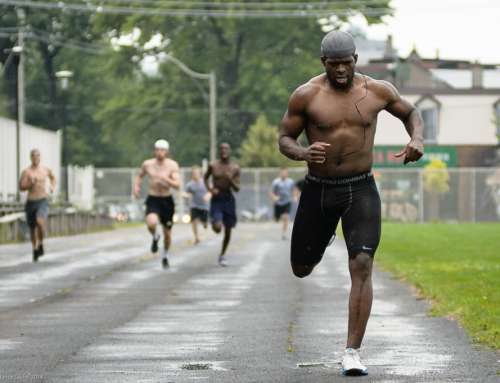
“Everyone wants to be a monster until they see what REAL monsters do!”
I have been using this quote a lot lately because it resonates with me so deeply.
One morning, during my usual early routine, I got an idea. I’d ask some of my athletes how their friends, and other athletes they know, see one of my training facilities.

Wayne Moore is a running back drafted by the Montreal Alouettes who had trained at LPS for 4 years. He gave the same answer as the others: “LPS has a good reputation and it is understood that training here involves hard work.”
But he added, “There’s one catch though, Clance. Everyone wants to be a monster until they see what real monsters do.”
That statement hit me like a baseball bat cracking me upside the head!
People talk a good game. People want things: success, money, fame, the title of master strength coach. You name it.
But when they realize the work it will take to reach those goals, they run. Or it’s simply too much for them to handle, and they quit.
I see this over and over. An athlete shows up at the gym all pumped and ready to work, but when the work hits, they disappear. This goes for any profession, especially strength coaches.
Everyone nowadays seems to want a magic pill, or to be spoon-fed, or to believe they’ve learned enough from a few courses and certifications.
It doesn’t matter what you want to achieve in life. You have to put in the work.
This is why I praise the work. I never praise the athlete.
In our gym, the athlete with a strong work ethic is the one who gets praised. That builds a hard-working culture, and that culture breeds results. Culture creates Habits that produce Results.

What the Athlete Activation System (AAS) is
The Athlete Activation System (AAS) is how we build athletes at LPS. It’s centred on developing athleticism while building a strong, powerful and durable athlete.
Athletes train four days a week, with active rest in between.
Every athlete starts with an assessment and then Phase 0: Balancing the Body. Phase 0 is all about building a solid foundation. Here my coaches go after the athlete’s weaknesses: usually tight, weak muscles, plus mobility problems. Weak links like the knees and the VMO get fixed first, with work like Peterson step ups, before we load anything heavy. Would you build a house on sand? Neither would we.
What AAS is NOT
- It is not a cookie-cutter team strength day where 30 athletes do the same program.
- It is not a speed-and-agility camp that skips the strength that actually makes you fast.
- It is not random workouts designed to make you tired. Tired is easy. Better is the goal.
- It is not copying what a pro posts on YouTube. Every program is built around the athlete in front of us.
Then the real work begins…
…and we see who the real monsters are, and who are just wannabe monsters. The whole system runs 12 to 16 weeks. When you earn the right and you’ve built that base, then you qualify for higher intensity and higher volume work.

Yes, this puts significant stress on the central nervous system. But the organism (the athlete) WILL ADAPT!
I know many coaches, trainers and athletes believe no human can tolerate that combination of high intensity and high volume.
The fact is, it’s possible, and our coaches have the results to prove it! Read a day in the life of AAS with Gareth Morgan, or watch Wayne Moore’s 210kg back squat.
These are the monsters this system produces.
An observer once told me, “This system is like a pressure cooker, and over time the pressure creates diamonds.”

What the pros gave up
One of our clients, NHL All-Star defenseman P.K. Subban, once said: “At the Pro level, they don’t teach you to be a pro, you better be a pro before you even have a chance.”
So what does being a pro before you’re a pro actually look like? It looks like sacrifice. Let me show you.
P.K. Subban: an hour on the bus, each way, every day
P.K. Subban started with us at about 16 years old. He came in with shoulder issues, wrist issues and a weak lower back. He was overweight, slow and weak. We remapped his body in 14 weeks.
But here’s the part people forget. He took an hour-long bus ride each way, every day, to get to the gym. On the days he couldn’t make it, he’d beg to train on Sunday to make it up, or come in twice the next day. He made absolutely no excuses.
At the combine he was the top performer, by far. He was drafted by the Belleville Bulls (OHL), then by the Montreal Canadiens (NHL) in 2007, won the James Norris Memorial Trophy and signed a $72-million contract.
Denzel Clarke: 50 to 70 minutes each way, and training in the snow
Denzel Clarke‘s mother, Donna, is an ex-Olympian in the heptathlon who runs her own track and field club. She still sent her son to LPS. Denzel came in with back, shoulder and wrist issues, and we remapped his body.
He drove 50 to 70 minutes each way, every day, to the gym. On the days he couldn’t make it, he trained outside his house. Even in the snow.
In 2021 he was invited to the MLB National Combine and was the top performer, by far. He was drafted by the Oakland A’s with a $700,000 USD signing bonus and has since been called up to the 40-man roster.
Mark Friedman: off the hamster wheel
Mark Friedman spent years on the hamster wheel doing his team program. He came to us at 16 with lower back issues: short, chubby, weak and slow. At 5’10”, scouts wouldn’t look twice at him as a defenceman.
In one off-season we remapped his body and reversed his bad habits. He went from the bottom of his class to the top: he skated faster, shot harder, and people were scared to be hit by him. After a few more off-seasons of work, he was drafted and made it to the NHL.
And the one who waited too long
Late in his career, we helped former NHL player Joel Ward secure a contract extension worth an additional $9.75 million. Even so, he told us, “Man, I wish I had met you [LPS] when I was 16, I would have been a different player.”
See the pattern? Nobody handed these athletes anything. They gave up their comfort, their weekends and hours on the road. That’s what real monsters do.
What about young athletes?
Parents ask me this all the time: “Is my kid ready for this?” The answer is that young athletes don’t start where the pros are. They start with the Athlete Activation System Kids Foundation program, built for ages 8 to 13.
- Bodyweight mastery first. Before the barbell comes the squat, the push-up, the chin-up, the jump and the landing, done with full range of motion.
- No TRUE 1RM testing for beginners. We don’t load a new kid up and test a true one-rep max. We build technique and capacity first.
- Readiness depends on training age, not birth age. Training age means how long a kid has trained properly. A 12-year-old who has been coached the right way since age 7 or 8 is a very different athlete from a 12-year-old walking in on day one. Some kids do qualify for 1RM pushes. Some of the best young lifters in the world are 12 to 14 year olds doing 1RMs after training since they were 7 or 8.
- Supervision, always. Every rep is coached.
Worried that lifting will hurt your child’s growth? I tackle that myth head-on in Does Weight Training Stunt the Growth of Kids?
So, do you want to be a monster?
The system works, but only if you do the work. If you’re ready to see what real monsters do, learn more about LPS athlete strength and conditioning. If you can’t get to our gym, there’s online coaching.
About the Author: Clance Laylor

Related Articles