Your kid is 11. The rep coach wants a spring team, a summer team and “skills” in August. Another parent tells you, quietly, that everyone serious is doing it.
So you’re asking the question we get asked more than any other: should their child focus on one sport now, or keep playing a few?
Here’s the short answer. For most sports, early sport specialization — one sport, most of the year, before the teen years — isn’t the shortcut it looks like. The research links it to more overuse injuries and more burnout, and the athletes who make it to the top usually specialized later than you’d think.
That doesn’t mean less work. It means the right work, at the right age.
This guide gives you the facts, an age-by-age plan, the warning signs to watch for, and a step-by-step way to rebalance if your kid is already on the one-sport treadmill.
What Is Early Sport Specialization?
Researchers use a pretty specific definition. An athlete is specialized when they:
- Train in one sport more than 8 months a year,
- Treat it as their main sport, and
- Have quit other sports to focus on it. [1][8]
It’s “early” when it starts before about age 12, or before puberty. [1][8]
Notice what’s not on the list: working hard, loving one sport most, or having big goals. Those are great. The problem is one sport, all year, too young.
Why So Many Families Feel Pushed Into It
Youth sports today look nothing like they did a generation ago. In the GTA it’s rep hockey that bleeds into spring and summer, rep soccer with indoor winter seasons, travel tournaments most weekends, and private lessons on top.
And it costs. In a 2024 U.S. survey of 1,848 sports parents, families spent an average of $1,016 a year on a child’s main sport — up 46% since 2019. [12] When you’ve invested that much, stepping back feels like falling behind.
The worries we hear from parents are always the same:
- “If my child doesn’t play year-round, will they fall behind?”
- “Will scouts and colleges only look at kids who specialize?”
- “Didn’t the pros all start young?”
- “Will taking a season off cost them their spot?”
These are fair questions. Every one of them comes from a parent who wants the best for their kid. So let’s answer them with evidence, not fear.
Is Early Specialization Necessary to Reach the Elite Level?
For most sports, no.
Hockey, the sport most GTA families ask us about: when researchers surveyed 91 professional and NCAA hockey players, the average age they specialized was 14.3. They started playing sports at 4.5, so they spent about ten years playing other sports first. [3]
College athletes: in a survey of 303 NCAA Division I athletes across 19 sports, the average age of specialization was 14.9, and only 17.4% had specialized by age 12. [4] A separate study of 343 Division I athletes at a Midwest university found most were not highly specialized at any point in high school — just 16.9% were in Grade 9. The authors’ conclusion: early specialization “does not appear” to be necessary to become a Division I athlete. [22]
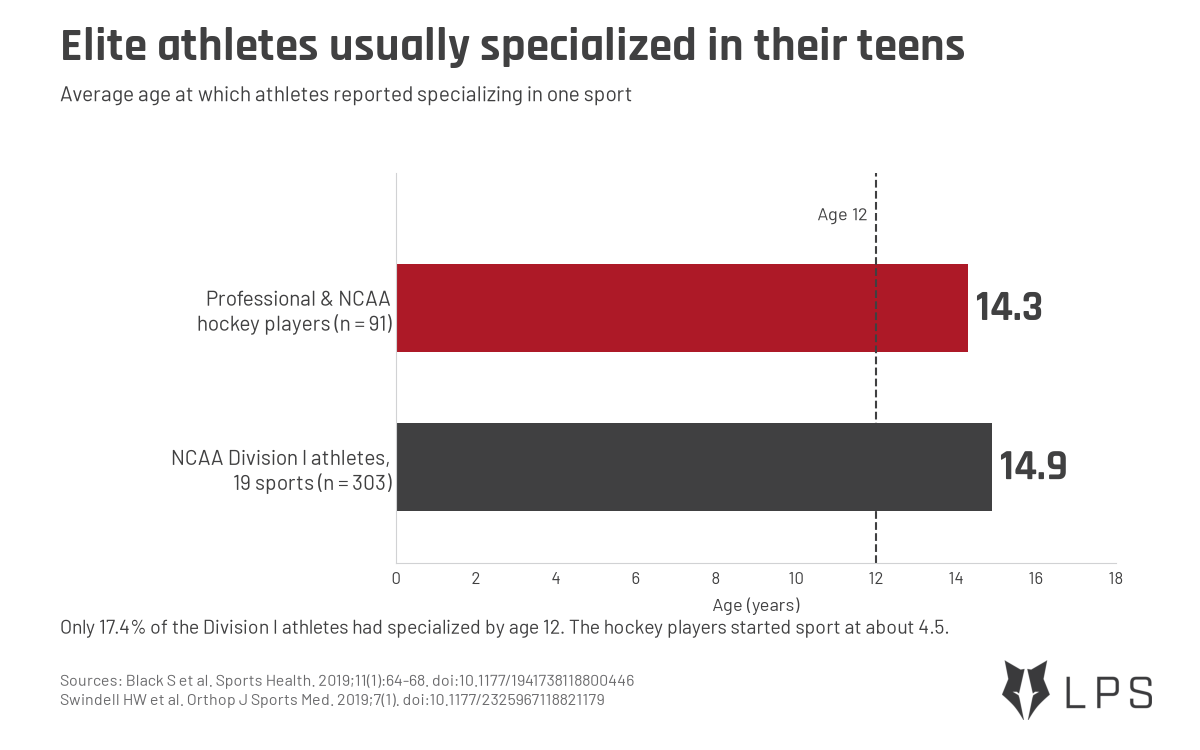
Elite athletes usually specialized around 14 or 15, not as young kids. Sources: Black et al. 2019; Swindell et al. 2019.
The big sports-medicine groups agree. The American Orthopaedic Society for Sports Medicine’s expert panel concluded there’s no evidence that young children benefit from early specialization in the majority of sports, and that early multi-sport play won’t hold athletes back from long-term success. [5]
There are real exceptions. Gymnastics, figure skating and diving are “early specialization” sports, because peak performance comes young and the hardest skills have to be learned before maturity. [7] If your child is in one of those, the rules are different — talk to their coach and a qualified strength coach.
But Canada’s own athlete-development model, Sport for Life’s LTAD 2.1, lists ice hockey, soccer, basketball and baseball as late-specialization sports. [7]
Tiger vs. Roger
Tiger Woods is the most famous early specialist ever. He was on national television at age two. [16]
Roger Federer took the other road. As a kid he sampled skiing, wrestling, swimming, skateboarding, basketball, handball, table tennis, badminton and soccer. [16] He went on to win 20 Grand Slam titles. [16]
Author David Epstein, who tells both stories in his book Range, puts it fairly: there are many paths to the top — but according to the research, Federer’s path is the typical one, and Tiger’s is the exception. [16] (Even Tiger, by his own account, played baseball and ran cross-country and track as a child. [16])
Federer’s own advice to kids, in a TV interview Epstein quotes:
“I would tell all the juniors and kids out there, do other sports too, for fun. Go play squash, go ride your bike, go play basketball, go ski, whatever it is…until you are in the mid-teens I think you can really do everything.” [16]
The quarterbacks who could have played baseball
Tom Brady was drafted by the Montreal Expos in the 18th round of the 1995 MLB Draft, as a power-hitting high-school catcher. [20]
Patrick Mahomes was drafted by the Detroit Tigers in the 37th round in 2014, as a pitcher. [20] In high school he was a three-sport star: quarterback, the star of the basketball team, and a baseball player who started at every position except catcher. [21]
Johns Hopkins Medicine adds LeBron James and soccer legend Abby Wambach to the list of stars who played several sports in high school before focusing on one. [8]
What Early Specialization Can Do for a Kid
To be fair, there are upsides:
- Faster early skill gains. More reps in one sport means sharper sport skills, sooner. A soccer player’s touch improves. A gymnast gets cleaner.
- Early wins. More practice often means making the top team, winning tournaments and getting noticed at 10 or 12.
- Confidence. Mastery feels good. Kids who get good at something often feel more capable everywhere.
- Access to better coaching. Higher-level programs can mean more expert instruction.
Here’s the catch. Success at 10 or 12 doesn’t reliably predict success at 18. [24] And every one of these benefits is only worth it when the workload is managed and the kid is still enjoying it.
The Risks of Early Sport Specialization
The real problem: demand outruns capacity
Here’s how a strength coach sees it.
Every sport puts a demand on a kid’s body: sprints, cuts, jumps, shots, throws. Every kid has a capacity: how much load their bones, tendons and muscles can handle and recover from.
Specialization grows the demand fast. More games, more practices, more of the exact same movements. Capacity doesn’t grow on the same schedule. It grows with age, with variety, with rest and with real strength work.
When demand keeps outrunning capacity, something gives.
And it rarely gives all at once. An overuse injury at 17 usually isn’t about this season. It’s the bill for years of the same movements with too little variety and recovery. Our view as coaches, not a lab finding: load adds up over years, not weeks.
Two athletes, one lesson
These are illustrative examples to show the idea — not real people, and not a prediction for any one child.
Athlete A picks one sport at 8. By 10, they play it 11 months a year: rep season, spring team, summer team, August skills camp. They get very good, very early. By 16, they’ve played the same movements for eight straight years with few real breaks, and their body has never been trained for anything else.
Athlete B plays hockey in winter, soccer in summer and whatever their friends are doing in between, until about 13. At 14 they choose a main sport, and add two days a week of strength, speed and movement work. They may be a step behind Athlete A at 12. By 17, they’ve built a bigger engine to carry the load.
Neither path guarantees anything. But Athlete B’s odds look a lot better — and the research below explains why.
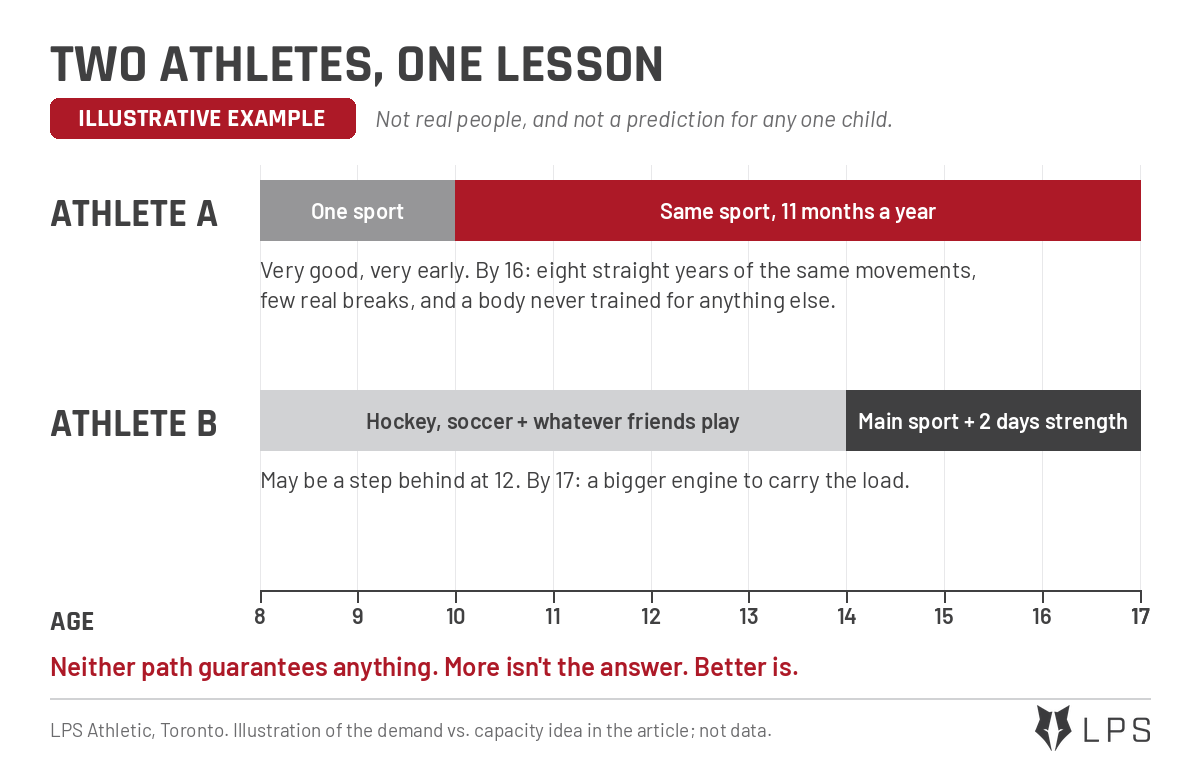
Illustrative example, not real athletes: early specialization vs. a multi-sport start.
More isn’t the answer. Better is.
1. More overuse injuries
Acute injuries happen in a moment — a bad fall, a collision. Overuse injuries build slowly, from the same motion repeated too often without enough recovery: stress fractures, tendinitis, growth-plate problems, Osgood-Schlatter, throwing-shoulder and jumping-knee pain.
This is where the evidence is strongest. A study of 1,190 athletes aged 7 to 18 found that specialized athletes had 36% higher odds of a serious overuse injury — even after accounting for age and hours played. [2]
A review that pooled several studies found highly specialized athletes were about 1.8 times as likely to have an overuse injury as low-specialization athletes. [6]
A 2017 study of 2,011 athletes aged 12 to 18 found the same pattern: highly specialized athletes were more likely to report an overuse injury in the past year (odds ratio 1.45), and those who played their main sport more than 8 months a year were more likely to report a lower-body overuse injury (odds ratio 1.66). [23]
Young athletes are especially vulnerable because their bones, muscles and tendons are still growing.
2. A smaller athletic toolbox
Every sport teaches the body something different. Basketball builds agility and spatial awareness. Soccer builds footwork and endurance. Gymnastics builds body control. Wrestling builds balance and strength. Track builds speed and power.
Kids who play several sports build a bigger movement vocabulary, and skills learned in one can carry into another. Coaches call this positive transfer. [25]
Steve Nash is the Canadian proof. He grew up in Victoria, B.C., playing soccer, and didn’t start basketball until he was 12 or 13. [17][18] He became a two-time NBA MVP and a Hall of Famer. [18] How did he catch up so fast? In his words:
“I was pretty good right away because when you are 12 or 13 it is more about what other sports you’ve played. If you are good at other sports you can translate it easily to any sport at that age.” [17]
One sport, all year, means the same patterns over and over — which can lead to muscle imbalances, limited mobility and gaps in basic athleticism. Sport for Life lists exactly these: one-sided preparation, poor basic movement skills, overuse injuries and early burnout. [7]
3. Burnout
Burnout is when the physical and emotional load becomes more than a kid can handle. The child who loved the game starts dreading it.
Specializing too young is linked to more psychological stress and to quitting sport early. [1]
Wayne Gretzky saw it coming decades ago. In 2008, as an NHL coach, he told the Globe and Mail:
“In youth hockey, in most cases, it’s really important for kids to play other sports – whether it’s indoor lacrosse or soccer or baseball. I think what that does is two things. One, each sport helps the other sport. And then I think taking time off in the off-season – that three- or four-month window – really rejuvenates kids so when they come back at the end of August, they’re more excited.” [15]
His own childhood? “I know, for myself, when the hockey season was over, I couldn’t wait to play baseball. I had no interest in playing ice hockey until September.” [15]
4. Quitting sport altogether
This is the irony. The path meant to make a kid great often ends with them walking away.
In a 2019 national survey, the Aspen Institute found the average child plays a sport for less than three years and quits by age 11 — most often because it stopped being fun. [11]
5. Stress, identity and social life
When a kid’s whole identity is “the hockey player,” a bad game, an injury or a cut can hit hard. The pressure comes from everywhere: coaches, parents, teammates, social media and the kid themselves.
Multi-sport kids also meet more teammates, more coaches and more team cultures. That’s where a lot of leadership and resilience gets built. Specializing early narrows all of it.
Here’s the Honest Part
The science isn’t finished. A 2022 review led by researchers at York University here in Toronto found there do appear to be risks to a highly specialized approach — but the reasons why are still largely unknown. [10]
So we’re not telling you one sport is evil. We’re telling you the odds, and how to stack them in your kid’s favour.
At What Age Should Kids Specialize? An Age-by-Age Guide
This guide follows Canada’s LTAD model [7], Hockey Canada’s player-development pathway [14] and U.S. pediatric guidance [8]. Ages are approximate. Kids grow at different rates.
Ages 6–9: play everything. Run, jump, throw, catch, skate, swim. Sport for Life calls this FUNdamentals: agility, balance, coordination and speed, built through play. [7] Hockey Canada strongly encourages kids at 7–8 to keep playing compatible sports. [14]
Ages 9–12: the skill window. Sport for Life calls ages 9 to 12, before the growth spurt, one of the most important periods for learning sport skills. [7] Its guideline for this stage: about three sessions a week in the main sport and three in other sports. [7] Keep two or three sports going.
Ages 12–15: start to narrow. If a child has a strong movement base, LTAD says they can pick a late-specialization sport between 12 and 15. [7] Hockey Canada’s Train to Train stage (boys 12–16, girls 11–15) adds more hockey focus with fewer other sports. [14] This is also the growth-spurt window, when training needs the most care.
Ages 15–16 and up: specialize, if they want to. The American Academy of Pediatrics recommends delaying single-sport specialization until about 15 or 16. [8][13] By now, a kid who chooses one sport is choosing it for themselves.
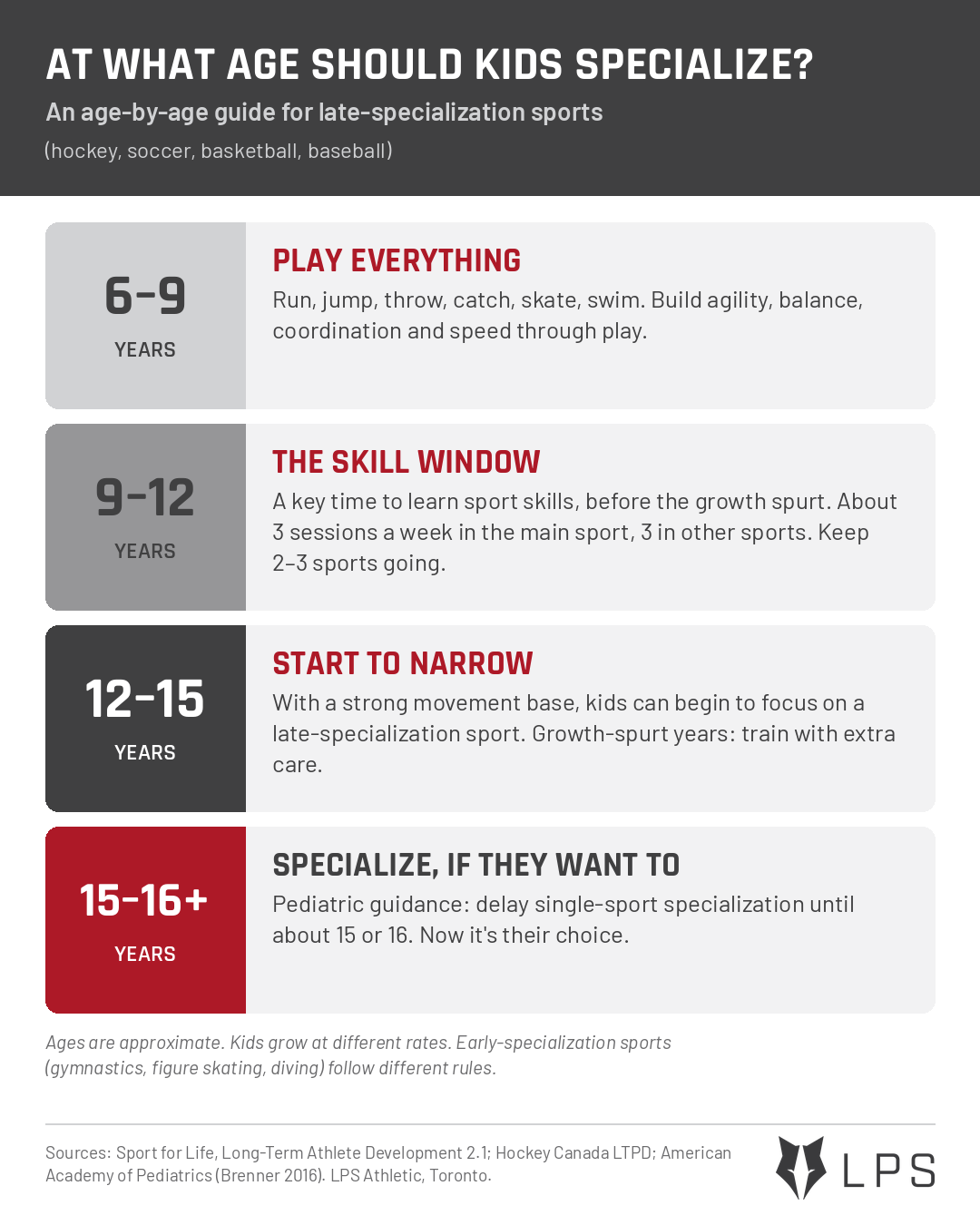
When to specialize: an age-by-age guide for hockey, soccer, basketball and baseball families.
How Many Hours Should My Child Train?
Here’s the simplest rule in youth sports, and it comes from real data:
Weekly hours of organized sport should not exceed your child’s age. A 12-year-old: 12 hours a week, max.
In the study of 1,190 young athletes, kids who trained more hours a week than their age had about twice the odds (2.07x) of a serious overuse injury. [2] Kids whose organized sport outweighed free play by more than 2 to 1 also had higher odds. [2]
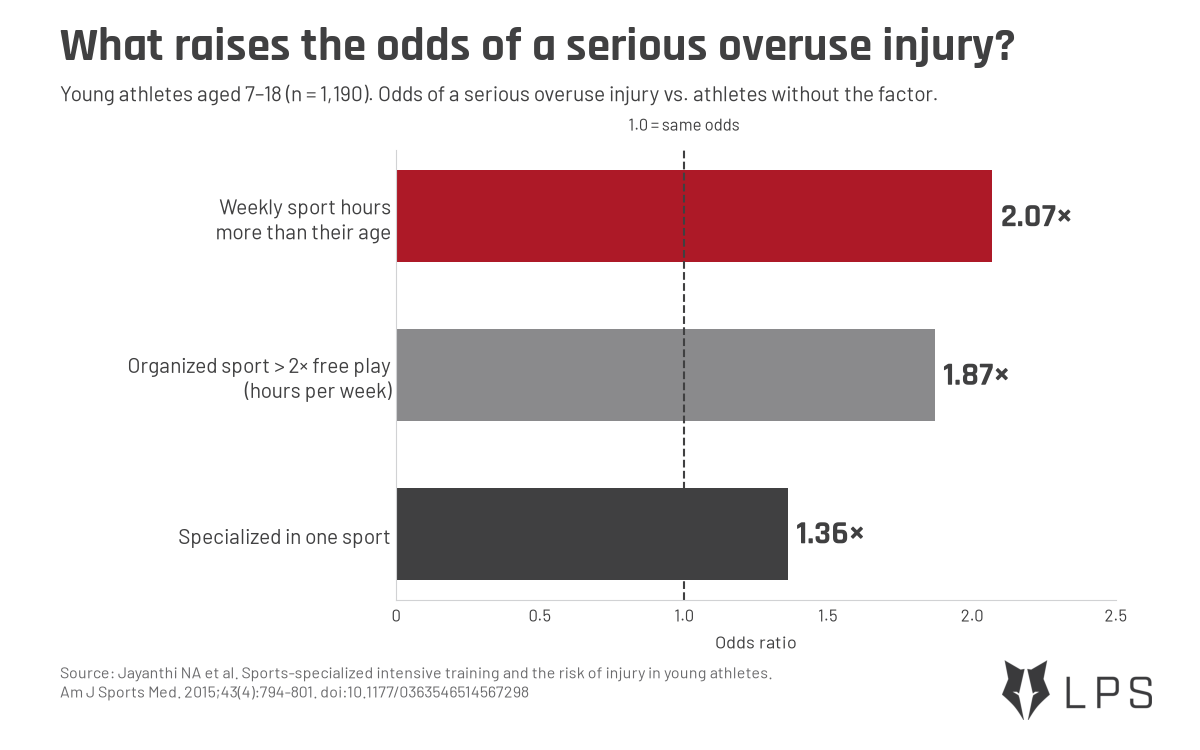
Training more hours than their age roughly doubled the odds of a serious overuse injury. Source: Jayanthi et al. 2015.
Guidelines summarized by National Athletic Trainers’ Association (NATA) also recommend:
- Delay specializing in a single sport as long as possible.
- Participate in one organized sport team per season (“one team at a time”).
- Play a single sport for less than 8 months per year.
- Participate in organized sport no more hours per week than their age in years (e.g., a 12-year-old should not exceed 12 hours/week of organized sport).
- Have at least 2 days of rest per week from organized training and competition.
- Take dedicated rest and recovery time at the end of each competitive season to promote physical and mental recovery and reduce burnout and injury risk. [8]
A sample week for a 12-year-old rep hockey player (in season)
| Day | What | Time |
|---|---|---|
| Mon | Off — free play, family, sleep | — |
| Tue | Team practice | 1.5–2 h |
| Wed | Strength & movement session | 1 h |
| Thu | Team practice | 1–1.5 h |
| Fri | Off — free play, family, sleep | — |
| Sat | Game | 2–3 h |
| Sun | Second sport or active play (basketball, swimming, ball hockey with friends); Strength & movement session | 1–2 h; 1 h |
Two full rest days. One sport-free day of play. Strength work that builds the athlete, not just more of the same skate.
What a Strength Coach Actually Does for Young Athletes
A good strength coach shouldn’t add another grind to your kid’s week. The job is to build the athlete under the sport.
Coaches call that foundation General Physical Preparation (GPP): strength, speed, mobility, coordination, balance and the ability to recover. Think of it as building the engine before worrying about the paint job.
In practice, a good youth strength coach:
- Assess movement first. Can your kid squat, hinge, land, sprint and rotate well? Gaps get fixed before load gets added.
- Builds strength progressively. Bodyweight first, then medicine balls, then free weights as they mature — the same order Sport for Life lays out. [7]
- Manages load. We look at the whole week — games, practices, school — not just the gym hour.
- Adjusts through growth spurts. Sport for Life calls for frequent musculoskeletal checks during the growth spurt. [7] When kids grow fast, coordination and tolerance change, and so should the plan.
- Talks to parents. Parents should know the plan and what the coach is seeing.
This isn’t a promise that your child will never get hurt. Nobody can promise that. It’s how you stack the odds.
Signs Your Kid Is Doing Too Much
Signs of burnout
- They used to beg to go to practice. Now you’re dragging them.
- More irritable, flat or teary than usual — especially around sport.
- Schoolwork slipping or trouble focusing.
- Tired all the time, even after a weekend off.
- Constant excuses to skip.
- They stop setting goals or caring about getting better.
Signs of an overuse injury
- Pain that lasts, or keeps coming back.
- Limping, favouring one side or changing how they move.
- Lots of “small” strains and sprains.
- Pain that wakes them up at night.
- Speed, strength or coordination dropping off for no clear reason.
- Hesitating on moves they used to do without thinking.
If you see these, don’t push through. Talk to your doctor or physiotherapist first, then their coaches.
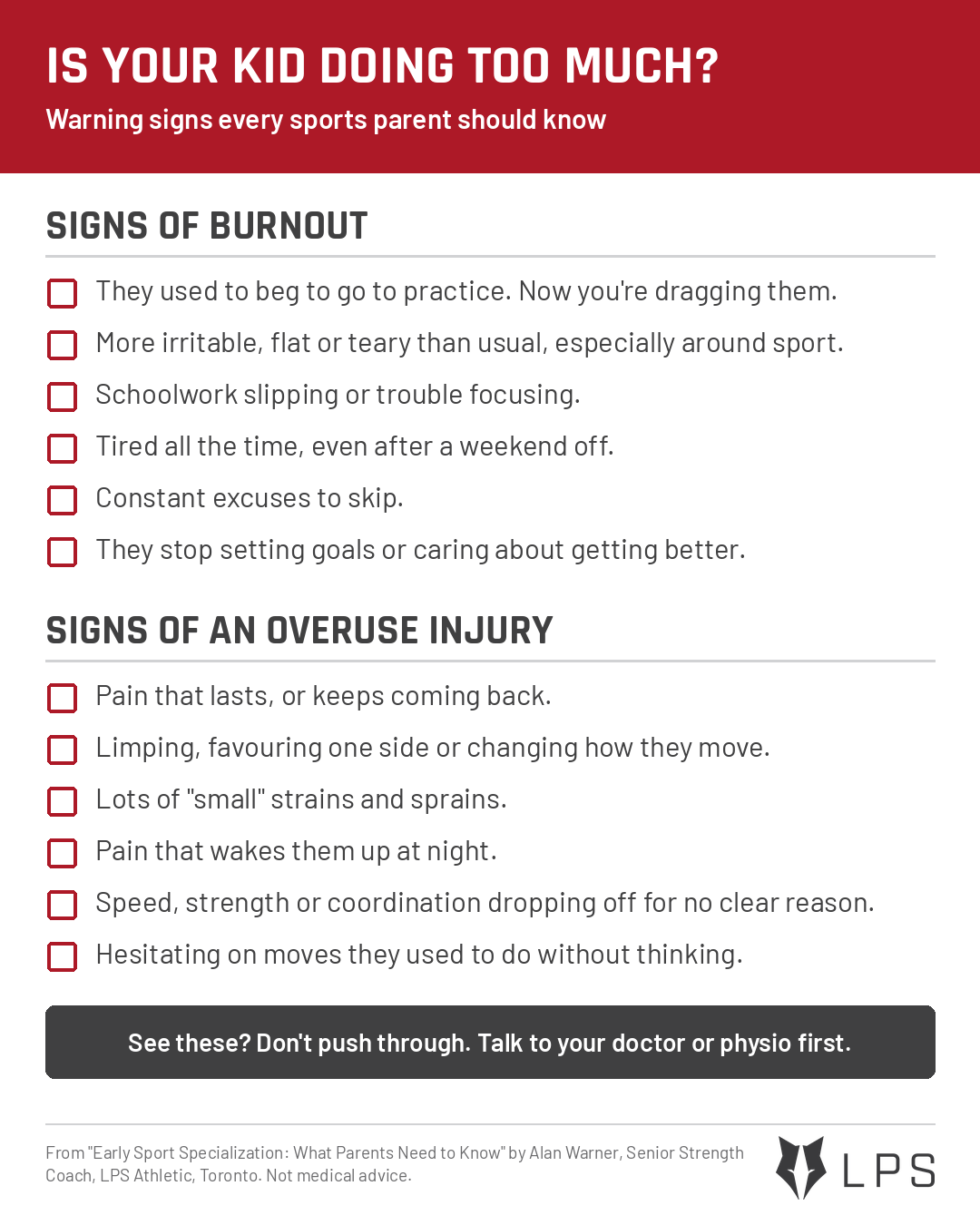
Save this checklist: signs your young athlete is doing too much.
How to Talk to Your Kid About Sport
Kids don’t have the life experience to answer “what are your goals?” So ask smaller questions — ones they can actually answer.
Ages 6–10
- “What was the most fun part of today?”
- “If you could play any game tomorrow, what would it be?”
Ages 10–13
- “What do you like most about your team? What’s the worst part?”
- “Is there another sport your friends play that you’d want to try?”
Ages 13+
- “Who are you doing this for — you, the coach or me? It’s okay if the answer isn’t you.”
- “What would you want to be better at a year from now?”
A few rules that help:
- Ask on the car ride, not right after a loss. Give them time.
- Listen more than you talk. No fixing, no lecture.
- Watch what they choose when nobody’s making them. That’s the real answer.
Specialized vs. Multi-Sport: The Quick Comparison
| Early single-sport path | Multi-sport, specialize later | |
|---|---|---|
| Skill growth | Faster early gains in one sport | Broader skills; sport-specific gains come later |
| Overuse injury risk | Higher — about 1.8x for high vs. low specialization [6] | Lower |
| Burnout and dropout | Linked to more stress and quitting early [1] | More variety; more chances to stay in sport |
| Elite outcomes | Not required in most sports [5] | Typical path for elite hockey and NCAA athletes (specialized ~14–15) [3][4] |
| Athleticism | Narrower movement base | Bigger “movement vocabulary” |
| Social life | One team, one culture | More teammates, coaches and cultures |
| Best fit | Gymnastics, figure skating, diving [7] | Hockey, soccer, basketball, baseball and most team sports [7] |
Action Plan for Parents: Moving to a More Balanced Routine
Already deep in one sport? Good news — you don’t have to blow anything up. Here’s the step-by-step.
Step 1. Count the hours. Add up every organized hour for one normal week: practices, games, lessons, camps. Compare it with your kid’s age. [2]
Step 2. Add two days off. Protect two days a week with no organized training. [8]
Step 3. Plan a real break from the main sport. Aim for no more than 8 months a year in one sport. [8] The American Academy of Pediatrics recommends at least three months off from the main sport across the year, in one-month blocks, plus one or two days off each week. [13] Mark the break on the calendar now, before the next season’s sign-up email hits.
Step 4. Pick a second sport that complements the first. Hockey players can play lacrosse or golf — lacrosse trains cutting and stick skills that carry onto the ice, and both fit Ontario’s spring and summer when the rinks go quiet. Baseball players can play golf or hockey — rotational power and a winter sport keep them moving when the diamonds are closed. Soccer players can play basketball or track — cutting, jumping and sprint work transfer cleanly, and both stay available through Ontario winters. Basketball players can play soccer or volleyball — endurance, footwork and jump-landing skills broaden the athletic base, with soccer outdoors in season and volleyball in the gym year-round. Volleyball players can play basketball or track — multi-directional agility and sprint mechanics support the jump game, and both run through the school year.
Connor McDavid grew up just north of Toronto. Around age seven or eight, he and his friend Tristan Joseph (son of former Maple Leafs goalie Curtis Joseph) started out playing lacrosse together. One year later, they were linemates on the York-Simcoe hockey team. [19]
Step 5. Bring back free play. Pickup basketball, road hockey, swimming at the cottage. Keep organized time from outweighing free play by more than 2 to 1. [2]
Step 6. Build the engine. Add a GPP strength-and-movement session that fixes weaknesses instead of repeating the sport.
Step 7. Have the conversation. Use the questions above. Make sure the plan is your kid’s plan too.
Step 8. Watch for the warning signs. Keep the checklist on the fridge. Act early.
Step 9. Talk to the coach. Most good coaches will back a plan that keeps your kid healthy and in the game longer.
Frequently Asked Questions
What is early sport specialization?
Early sport specialization is training in one sport for more than eight months a year, usually after quitting other sports, before about age 12 or before puberty. Most sports-medicine experts advise against it for most sports.
At what age should kids specialize in one sport?
For most sports, around 15 or 16, which is what the American Academy of Pediatrics recommends. Canada’s LTAD model says kids with a strong movement base can choose a late-specialization sport like hockey or soccer between 12 and 15. Gymnastics, figure skating and diving are exceptions that specialize earlier.
How many hours a week should my child train?
A common evidence-based rule is no more hours of organized sport per week than your child’s age, and no more than 16 hours. In one study, young athletes who trained more hours than their age had about twice the odds of a serious overuse injury.
Is playing hockey all year bad?
Hockey is a late-specialization sport in Canada’s LTAD model, and Hockey Canada encourages young players to keep playing other sports. In a study of professional and college hockey players, the average age they specialized was 14.3. A break from the ice and a second sport are usually healthier for younger players.
Does playing multiple sports make better athletes?
Playing several sports builds a wider range of movement skills, and research on elite hockey and NCAA athletes shows most specialized around 14 or 15, not in childhood. Early multi-sport play does not hold athletes back from long-term success.
How much rest does a young athlete need?
Guidelines recommend at least two days off a week from organized training and competition, and no more than eight months a year in one sport.
What are the warning signs my child is doing too much?
Watch for lost enjoyment, mood changes, constant fatigue, excuses to skip practice, and pain that lasts or keeps coming back. If you see pain or changes in how your child moves, check with a doctor or physiotherapist.
What if my child wants to specialize?
That’s okay, especially in the mid-teens. Keep weekly hours below their age, protect two rest days a week, plan a break each year, and add strength and movement training that builds the whole athlete.
What is LTAD in Canada?
Long-Term Athlete Development (LTAD) is Sport for Life’s framework for developing athletes in stages, from Active Start through Active for Life. It classes most team sports, including hockey, soccer, basketball and baseball, as late-specialization sports.
Final Thoughts
Early specialization looks like the fast lane. The wins come quick, the jerseys look great, and nobody wants their kid left behind.
But kids aren’t mini adults. Their bodies, minds and emotions are still growing.
The goal isn’t just to raise a great athlete. It’s to raise a healthy, confident, resilient young person who still loves the game at 18 — and has the strength, speed and durability to compete when it counts.
The best athlete at 12 isn’t always the best athlete at 18. The ones who win the long game are the ones who stay healthy, stay hungry and keep loving it.
That’s how you get off the hamster wheel.
About LPS Athletic: LPS Athletic is a strength and conditioning centre for athletes in Toronto.
References
- Jayanthi N, Pinkham C, Dugas L, Patrick B, LaBella C. Sports specialization in young athletes: evidence-based recommendations. Sports Health. 2013;5(3):251-257. https://doi.org/10.1177/1941738112464626
- Jayanthi NA, LaBella CR, Fischer D, Pasulka J, Dugas LR. Sports-specialized intensive training and the risk of injury in young athletes: a clinical case-control study. Am J Sports Med. 2015;43(4):794-801. https://doi.org/10.1177/0363546514567298
- Black S, Black K, Dhawan A, Onks C, Seidenberg P, Silvis M. Pediatric sports specialization in elite ice hockey players. Sports Health. 2019;11(1):64-68. https://doi.org/10.1177/1941738118800446
- Swindell HW, Marcille ML, Trofa DP, et al. An analysis of sports specialization in NCAA Division I collegiate athletics. Orthop J Sports Med. 2019;7(1). https://doi.org/10.1177/2325967118821179
- LaPrade RF, Agel J, Baker J, et al. AOSSM Early Sport Specialization Consensus Statement. Orthop J Sports Med. 2016;4(4):2325967116644241. https://doi.org/10.1177/2325967116644241
- Bell DR, Post EG, Biese K, Bay C, Valovich McLeod T. Sport specialization and risk of overuse injuries: a systematic review with meta-analysis. Pediatrics. 2018;142(3):e20180657. https://doi.org/10.1542/peds.2018-0657
- Sport for Life. Long-Term Athlete Development 2.1. https://sportforlife.ca/wp-content/uploads/2017/04/LTAD-2.1-EN_web.pdf
- National Athletic Trainers’ Association. Official Statement in Support of Sport Specialization Recommendations for Adolescent and Young Athletes (2019). https://www.nata.org/sites/default/files/2025-08/youth_sports_specialization_recommendations.pdf
- DiFiori JP, Benjamin HJ, Brenner J, et al. Overuse injuries and burnout in youth sports: a position statement from the American Medical Society for Sports Medicine. Clin J Sport Med. 2014;24(1):3-20. https://doi.org/10.1097/JSM.0000000000000060
- Mosher A, Till K, Fraser-Thomas J, Baker J. Revisiting early sport specialization: what’s the problem? Sports Health. 2022;14(1):13-19. https://doi.org/10.1177/19417381211049773
- Aspen Institute Project Play / Utah State University Families in Sport Lab. Survey: Kids quit most sports by age 11. Aug 1, 2019. https://projectplay.org/news/kids-quit-most-sports-by-age-11
- Aspen Institute Project Play. Family spending on youth sports rises 46% over five years (2024 National Youth Sports Parent Survey, n = 1,848). Feb 24, 2025. https://projectplay.org/news/2025/2/24/project-play-survey-family-spending-on-youth-sports-rises-46-over-five-years
- Brenner JS; AAP Council on Sports Medicine and Fitness. Sports specialization and intensive training in young athletes. Pediatrics. 2016;138(3):e20162148. https://doi.org/10.1542/peds.2016-2148
- Hockey Canada. Long-Term Player Development pathway. https://cdn.hockeycanada.ca/hockey-canada/Hockey-Programs/Coaching/Downloads/ltpd_pyramid_e.pdf
- Duhatschek E. The Great One’s message to parents: Let your kids have fun. The Globe and Mail. Sept 26, 2008. https://www.theglobeandmail.com/sports/hockey/the-great-ones-message-to-parents-let-your-kids-have-fun/article17971897/
- Epstein D. Here’s why Federer’s developmental story should be as famous as he is. Range Widely (newsletter by the author of Range). Oct 3, 2022. https://davidepstein.substack.com/p/heres-why-federers-developmental-22-10-03
- NBA.com. My Amazing Journey: Steve Nash (2007–08 season preview interview). Archived Apr 12, 2008. https://web.archive.org/web/20080412082139/http://www.nba.com/preview2007/journey_nash.html
- Phoenix Suns / NBA.com. Steve Nash: The unlikely journey of a two-time MVP. https://www.nba.com/suns/features/steve-nash-unlikely-journey-two-time-mvp
- Zeisberger M. The Barn to hockey stardom: Cujo’s role bringing up Connor McDavid. Toronto Sun. Jan 3, 2015. https://torontosun.com/2015/01/03/the-barn-to-hockey-stardom-cujos-role-bringing-up-connor-mcdavid — see also NHL.com Q&A, Apr 10, 2023: https://www.nhl.com/news/connor-mcdavid-exclusive-q-a-with-nhl-com-part-3-343314406
- MLB.com. NFL, NBA players drafted by MLB teams. https://www.mlb.com/news/nfl-nba-players-drafted-by-mlb-teams
- MLB.com. Patrick Mahomes’ baseball past, explained. https://www.mlb.com/news/patrick-mahomes-baseball-past-explained
- Post EG, Thein-Nissenbaum JM, Stiffler MR, et al. High school sport specialization patterns of current Division I athletes. Sports Health. 2017;9(2):148-153. https://doi.org/10.1177/1941738116675455
- Post EG, Trigsted SM, Riekena JW, et al. The association of sport specialization and training volume with injury history in youth athletes. Am J Sports Med. 2017;45(6):1405-1412. https://doi.org/10.1177/0363546517690848
- Güllich A, Macnamara BN, Hambrick DZ. What Makes a Champion? Early Multidisciplinary Practice, Not Early Specialization, Predicts World-Class Performance. Perspect Psychol Sci. 2022;17(1):6-29. https://doi.org/10.1177/1745691620974772
- Abernethy B, Baker J, Côté J. Transfer of pattern recall skills may contribute to the development of sport expertise. Appl Cogn Psychol. 2005;19(6):705-718. https://doi.org/10.1002/acp.1102
About the Author: Alan Warner

Related Articles